New LibrePlanet LiveCode users group

I’ve recently been involved in a project with a customer to set up their development team to use LiveCode on Debian workstations. If you haven’t heard about LiveCode, they recently had 3,342 backers pledge £493,795 of the initial £350,000 goal on Kickstarter. That’s quite an accomplishment! I am not involved in the development part of this project, only in providing infrastructure support and services.

Since we needed to start working on documentation and I already work with other colleagues via IRC, I thought it would be useful to start a wiki space and IRC channel, and other resources via the dedicated resources provided by the Free Software Foundation in addition to upcoming resources that may be provided by RunRev, the creators of LiveCode.

The goal here is to collaborate with the community and help RunRev in this initial transition to open sourcing LiveCode, while offloading some of the self support to the FSF infrastructure (via LibrePlanet which is their community portal/resource).

If anyone is interested, a few initial resources and links have been put together already.

It looks like many people are already using LiveCode on Ubuntu, judging by the many screenshots in existing tutorials and guides. I hope other Debian derivatives benefit from this and perhaps even other distributions.
A nicer LUKS full disk encryption passphrase prompt in Debian 7 (Wheezy)

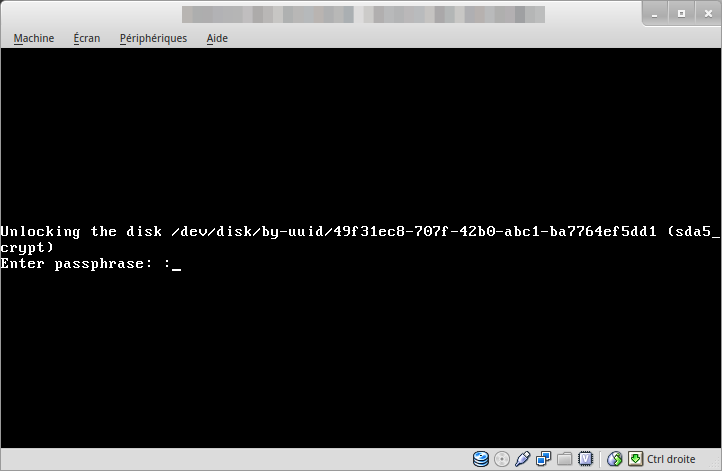
When installing Debian on a new system, if you don’t install Plymouth and you use full disk encryption, the passphrase prompt will come up in a text console which is not very pleasing to the modern eye:

LUKS-text-prompt.png

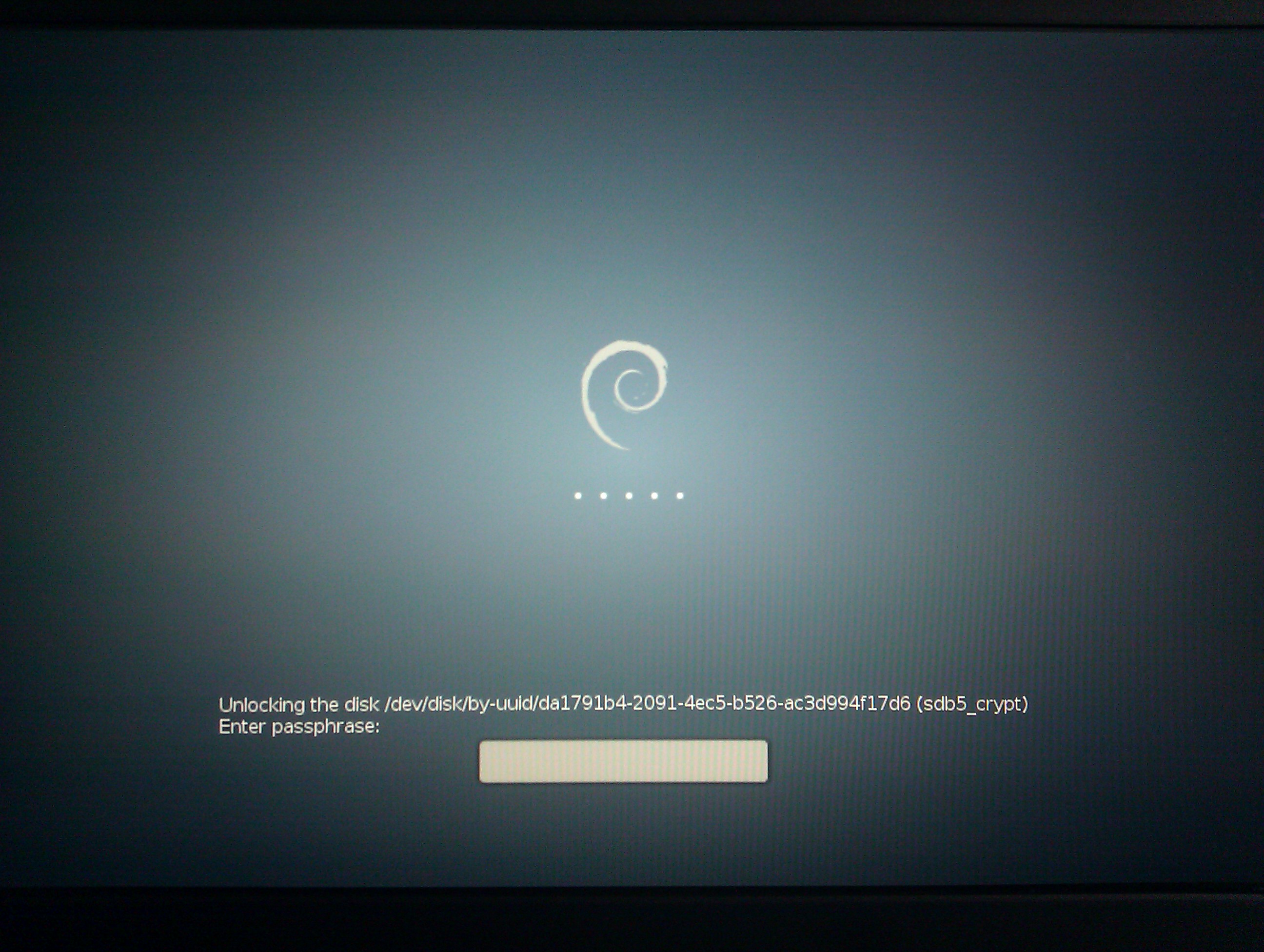
After much experimentation, I found the Joy theme from the available Plymouth themes provided a much better experience. It was created by Audrien Auburg and adapted from an Edubuntu theme by Jonathan Carter for use with Plymouth. This is an excellent example of Ubuntu functionality brought back into Debian for the benefit of all.

This is how to install such a boot theme in a new Debian system using an Intel graphics chipset:

$ sudo -s
# apt-get install plymouth plymouth-drm

Edit /etc/initramfs-tools/modules and add the modules required for modesetting:

# KMS
intel_agp
drm
i915 modeset=1

Apply the Joy theme and make the changes effective:


# /usr/sbin/plymouth-set-default-theme joy
# update-initramfs -u

And here is the result:

IMG_20130422_132413

If you have another graphics chipset, or if you want more details about setting Plymouth or changing to other themes, check the Debian wiki documentation about Plymouth for more specific instructions.

Also keep in mind this is not very useful on fast SSD-equiped systems: if you don’t use full-disk encryption, the boot sequence is so fast that you won’t see the theme much!

24 mai: 5@7 ASTUS – 24e promotion de finissants en informatique de l’Université de Sherbrooke

JF Yelle invite:

Rencontre printannière des anciens de la promotion Astus.
On va prendre la bière, simplement… à l’Amère à boire, le 24 mai 2013 prochain à compter de 16h.

Assurez-vous de bien vous inscrire et de nous signifier votre présence. Si les inscriptions sont suffisantes, nous pourrons offrir des petites bouchées à un prix modique. toutefois, il sera toujours possible de manger sur place.

Si vous utilisez LinkedIn est que vous faites partie de cette promotion (ASTUS), vous pouvez vous inscrire sur le groupe.

Je crois que si vous étiez dans les JESUS, MILLENUS, MAXIMUS, SPARTACUS et autres qui nous ont cottoyé vous êtes aussi les bienvenu(e)! 🙂

Vous pouvez aussi m’écrire si vous préférez ne pas utiliser Facebook, je ferais suivre à JF.

La nouvelle application La Presse+: une attaque à la liberté de presse

Aujourd’hui le quotidien québécois La Presse annonçait en grande pompe le lancement de son application La Presse+.

Cette application et l’approche de La Presse sont un net recul de tout ce qu’on voit sur l’approche libre et ouverte aux données, à l’information et à la technologie.

Je veux bien monnayer des contenus, mais je considère que c’est un recul incroyable et ça prouve au contraire un manque de vision et un mépris direct pour la liberté technologique et la transparence que recherchent les citoyens québécois.

C’est l’affirmation de l’ère de l’information à deux vitesses: ceux qui auront les moyens de se payer le dernier « iMachin » et le reste.

Apple est tout sauf un exemple d’ouverture ou d’audiences « larges », cette entreprise contrôle tout de ses appareils et imposes ses règles aux éditeurs. Bien sûr, c’est du « business as usual ». C’est ça la liberté de presse? Je suppose que tous les articles seront méticuleusement vérifiés pour respecter les règles d’Apple à ce sujet.

Dans son billet à ce sujet, Michelle Blanc célèbre cet accomplissement… même si elle est incapable d’y accéder avec son « vieux iPad » déjà désuet. D’autres parmi nos « visionnaires numériques » québécois comme M. Robert Gérin-Lajoie commentent à ce sujet […] [La Presse a] surtout compris que l’avenir réside dans l’ouverture. C’est simple les publicitaires veulent et exigent une audience large![…].

Suite à mes commentaires, Michelle commente sur G+:
Sélection_028

Le problème n’est pas d’avoir une application Android, gageons que si il y en a une équivalente elle serait disponible uniquement sur Google Play, ce qui est tout aussi inacceptable.

La Presse a manqué une belle occasion de faire une API ouverte avec un accès libre à ses informations – plusieurs modèles d’affaires pourraient aider à monayer ces accès. Ça permettrait entre autre à n’importe qui de développer d’autres services connexes, de s’alimenter, d’analyser, croiser ces données… les archiver? Il n’est pas trop tard, mais Michelle se borne à m’accuser de prêcher pour une « religion ».

Quelle tristesse. C’est ça les leaders d’opinion qui enseignent à nos informaticiens et artisans de l’information.

Il ne faut pas s’étonner si on se fait fourrer, comme on dit en bon québécois, si même pour lire le journal il faudra acheter un iBidule.

Vive la liberté pour les audiences « larges ».

Quel gâchis.

Note: Pour commenter l’annonce de La Presse sur G+, c’est par ici.

Moving on: how?

I am really sad to see so much energy spent by the community criticizing Canonical and on Canonical’s side, trying to explain and justify so many decisions and actions.

My main concern is all this energy being directed where it doesn’t stand a chance to make a difference, as we know all the rocket pieces are being discarded. I invite you to consider focusing on other projects that need people like you:

  • Start a LibrePlanet group in your area. This is very much like a LoCo Team, except its focus is on 100% free open source software. This is sponsored by the Free Software Foundation and staffed with professional, responsive, full-time system administrators. I started LibrePlanet Québec right about when I stepped down from Ubuntu Québec. They also have a mission statement and a code of conduct which will feel familiar to any Ubuntu community contributor/member.. This also means it’s inclusive of Ubuntu users in your area.
  • Trisquel – an Ubuntu derivative focused on removing all non-free software while remaining as close to Ubuntu as possible. There is a lot of work remaining to achieve this. Trisquel 6 which is essentially Ubuntu 12.04 LTS, is just around the corner. I learned a lot when I started using Trisquel primarily instead of Ubuntu, about a year ago. Ubuntu help, documentation, PPAs and resources apply directly, and the community is very friendly and detail-oriented. Ethics and philosophy are valued as much and sometimes more than technical criteria when providing help.
  • Debian – Where it all begun 🙂 I am using this as my primary OS now. Debian is working with the FSF to be recognized as 100% free as per FSF’s guidelines. There are rough edges which I recognize as opportunities to contribute, for example the lack of language-selector-gnome. It’s taking me some time to adjust to the project’s resources but I even re-organized Debian Quebec and requested a mailing list (since approved), and got a very warm welcome from friends and colleagues using it in my area. I guess I miss my LoCo action and excitement, I hope to put my experience in this area to good use in Debian. There are even talks about forming a Welcome Committee for Ubuntu expats there.

There are many more out there, but I wanted to share my path after my past Ubuntu involvement. If you’re on IRC, come join -expats on OFTC, perhaps we can come up with other ideas. Perhaps it will help you actually finding a way you can contribute to free open source software in other ways than you did with Ubuntu.

Life is short!


Consultant et conférencier en logiciels libres et GNU/Linux basé à Montréal, Québec (Canada)